Good news, everyone! jank has a new custom intermediate representation (IR) and we're using it to optimize jank to compete with the JVM. We'll dive into more of that today, but first I want to say thank you to my Github sponsors and to Clojurists Together for sponsoring me this whole year. You all are helping a great deal. I am still searching for a way to continue working on jank full-time with an income which will cover rent and groceries, so if you've not yet chipped in a sponsorship, now's a great time!
What is an intermediate representation (IR)?
Compilers often represent programs as a more abstract set of instructions than a target CPU instruction set can afford. This has a few added benefits. Firstly, the program can be represented in a way which could later be lowered to different CPU architectures, such as x86_64 or arm64. Since intermediate representations are often higher level than CPU architectures, they can generally be more portable. Secondly, IRs can be specifically designed to represent the program in a way which makes writing certain optimizations easier, such as single static assigment (SSA) form. Finally, IR designers get to choose the level of abstraction of the IR to match the semantics they're aiming to represent, which can either make an IR more general or more specific to a certain language.
There are many common popular IRs, such as the JVM's bytecode, the CLR's common intermediate language (CIL), GCC's GIMPLE, LLVM's IR, and so on. Some compilers may move the program through multiple IRs during compilation.
Custom IR rationale
Historically, jank has not been an optimizing compiler. We've delegated basically all of that work to LLVM, based on the C++ or LLVM IR which we would generate. However, LLVM IR works at a very low level, compared to Clojure. It has no concept of Clojure's vars, transients, persistent data structures, lazy sequences, and so on. Clojure's dynamism is granted by a great deal of both polymorphism and indirection, but this means LLVM has very few optimization opportunities when it's dealing with the LLVM IR from jank.
The optimization work done previously on jank helped optimize its runtime, and the compiler itself, but less so the code being compiled by the compiler. In the past two months, I have sought to change this.
I wanted an IR which operated at the level of Clojure's semantics. This would be much higher level than LLVM IR and even much higher level than JVM's bytecode. Since I'm not building a general virtual machine (VM) or compiler platform, I don't need to generalize the IR for different languages. I can make jank's IR specifically tailored to jank, which gives us even more power for optimizations. As far as I know, no Clojure dialects have taken this step.
Custom IR details
I have written a reference for jank's IR in the jank book here. This reference is targeted at people who're working on jank itself, since I'm making no promises on the stability of jank's IR at this point. However, I will copy some of that here to illustrate jank's IR and help provide a mental model for what's to come. Let's examine this simple Clojure function.
(defn greet [name]
  (if (= "jeaye" name)
    (println "Are you me?!")
    (println (str "Hello, " name "!"))))
jank's IR is stored in memory as C++ data structures, but it is renderable to Clojure data for debugging and testing. This is not full serialization, since it cannot round-trip back into the jank compiler from the IR, due to all of the Clang AST internal data we have on hand. Let's take a look at the jank IR module for this function.
{:name user_greet_82687
 :lifted-vars {clojure_core_SLASH_str_82694 clojure.core/str
               clojure_core_SLASH_println_82691 clojure.core/println
               clojure_core_SLASH__EQ__82689 clojure.core/=}
 :lifted-constants {const_82693 "!"
                    const_82692 "Hello, "
                    const_82690 "Are you me?!"
                    const_82688 "jeaye"}
 :functions [{:name user_greet_82687_1
              :blocks [{:name entry
                        :instructions [{:name greet :op :parameter :type "jank::runtime::object_ref"}
                                       {:name name :op :parameter :type "jank::runtime::object_ref"}
                                       {:name v3 :op :literal :value "jeaye" :type "jank::runtime::obj::persistent_string_ref"}
                                       {:name v4 :op :var-deref :var clojure_core_SLASH__EQ__82689 :type "jank::runtime::object_ref"}
                                       {:name v5 :op :dynamic-call :fn v4 :args [v3 name] :type "jank::runtime::object_ref"}
                                       {:name v7 :op :truthy :value v5 :type "bool"}
                                       {:name v8 :op :branch :condition v7 :then if0 :else else1 :merge nil :shadow nil :type "void"}]}
                       {:name if0
                        :instructions [{:name v9 :op :literal :value "Are you me?!" :type "jank::runtime::obj::persistent_string_ref"}
                                       {:name v10 :op :var-deref :var clojure_core_SLASH_println_82691 :type "jank::runtime::object_ref"}
                                       {:name v11 :op :dynamic-call :fn v10 :args [v9] :type "jank::runtime::object_ref"}
                                       {:name v12 :op :ret :value v11 :type "jank::runtime::object_ref"}]}
                       {:name else1
                        :instructions [{:name v13 :op :literal :value "Hello, " :type "jank::runtime::obj::persistent_string_ref"}
                                       {:name v14 :op :literal :value "!" :type "jank::runtime::obj::persistent_string_ref"}
                                       {:name v15 :op :var-deref :var clojure_core_SLASH_str_82694 :type "jank::runtime::object_ref"}
                                       {:name v16 :op :dynamic-call :fn v15 :args [v13 name v14] :type "jank::runtime::object_ref"}
                                       {:name v17 :op :var-deref :var clojure_core_SLASH_println_82691 :type "jank::runtime::object_ref"}
                                       {:name v18 :op :dynamic-call :fn v17 :args [v16] :type "jank::runtime::object_ref"}
                                       {:name v19 :op :ret :value v18 :type "jank::runtime::object_ref"}]}]}]}
jank's IR is SSA-based, meaning that each name is only assigned once. This makes entire categories of optimizations much easier to reason about. jank's IR is also represented as a control flow graph (CFG), which is composed of one or more basic blocks, each with exactly one terminating instruction (branch, jump, throw, ret, etc).
As we can see from the IR module, jank handles the lifting of vars and constants, and it has instructions at the level of Clojure's semantics, for dereferencing vars, calling functions, and so on. Let's take a look at the generated C++ from this IR.
extern "C" jank::runtime::object_ref
user_greet_19_1(jank::runtime::object_ref const greet, jank::runtime::object_ref name)
{
  auto const v3(const_33);
  auto const v4(clojure_core_SLASH__EQ__34->deref());
  auto const v5(jank::runtime::dynamic_call(v4, v3, name));
  auto const v7(jank::runtime::truthy(v5));
  if(v7)
  {
    auto const v9(const_35);
    auto const v10(clojure_core_SLASH_println_36->deref());
    auto const v11(jank::runtime::dynamic_call(v10, v9));
    return v11;
  }
  else
  {
    auto const v13(const_37);
    auto const v14(const_38);
    auto const v15(clojure_core_SLASH_str_39->deref());
    auto const v16(jank::runtime::dynamic_call(v15, v13, name, v14));
    auto const v17(clojure_core_SLASH_println_36->deref());
    auto const v18(jank::runtime::dynamic_call(v17, v16));
    return v18;
  }
}
If you compare the C++ to the IR, you can immediately see the correlation. The C++ variables are named to match the IR variables. A var dereference just becomes a call to ->deref() on the var. A dynamic call just becomes a jank::runtime::dynamic_call. This is intentional.
Optimizing the IR
It took about six weeks to design and implement the IR, including reworking our C++ code generation to generate from the IR instead of from jank's AST. At this point, we're not yet running any optimization passes on the IR. However, we have everything we need to start doing that. I wanted to prioritize getting the new IR pipeline merged, rather than building it out as much as possible, since six weeks is already a long time to be branched from main. Now that the IR is merged in, my approach will be to pick up one benchmark at a time and optimize it as needed until I'm satistified and/or cannot optimize it any further. Some of those optimizations will involve the IR directly, while others will not.
If you're interested in more of the technical development side of this IR, there are a few videos on the jank TV YouTube channel from the various Twitch streams I did while working on the IR. These videos go way into the weeds of implementing things.
With the new IR introduced, let's jump into optimizing our first benchmark: recursive fibonacci.
Interlude
Before we proceed, please consider subscribing to jank's mailing list. This is going to be the best way to make sure you stay up to date with jank's releases, jank-related talks, workshops, and so on. It's very low traffic.
Optimizing recursive fibonacci
Our first benchmark for this round of optimization is a recursive fibonacci implementation. It's just five lines long. Our goal is to have jank be at least as fast as Clojure JVM, if not faster, but we have to earn it.
(defn fibonacci [n]
  (if (<= n 1)
    n
    (+ (fibonacci (- n 1))
       (fibonacci (- n 2)))))
This may seem like a trivial benchmark to optimize. You might wonder why would this be representative of a real world application. In reality, this benchmark covers some essential aspects of the compiler and runtime.
- Polymorphic arithmetic and relational predicates. Basically every program crunches numbers and needs to do so quickly.
- Recursion. Many popular algorithms, especially in Lisps, are recursive. Being able to handle these patterns efficiently is important.
- Garbage creation and collection. The trash truck may come every week, but that doesn't mean we should be generating as much garbage as we can.
- In general, the ability for the language runtime to get out of the way. If we're trying to calculate fibonacci numbers, we don't want anything showing up in the profiler which is unrelated to fibonacci numbers.
As we optimize, throughout this post, consider these four categories and how each optimization we do can be categorized.
Baseline fibonacci timing
We're going to use Clojure JVM to get our baseline benchmark numbers and then we'll aim to beat those numbers with jank.
Note that all numbers in this post are measured on my five year old x86_64 desktop with an AMD Ryzen Threadripper 2950X on NixOS with OpenJDK 21. When I say "JVM" in this post, I mean OpenJDK 21.
❯ clojure -Sdeps '{:deps {criterium/criterium {:mvn/version "0.4.6"}}}'
Clojure 1.12.4
user=> (require '[criterium.core :refer [quick-bench]])
nil

user=> (defn fibonacci [n]
  (if (<= n 1)
    n
    (+ (fibonacci (- n 1))
       (fibonacci (- n 2)))))
#'user/fibonacci

user=> (quick-bench (fibonacci 35))
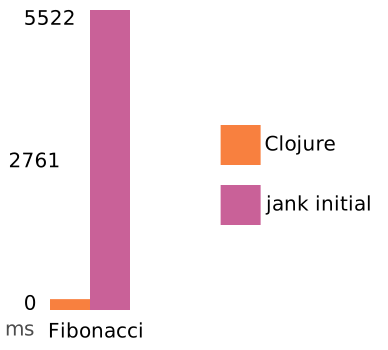
Clojure takes about 200 milliseconds to calculate (fibonacci 35). This is our baseline!
Be careful of lein repl
Note that I originally did my benchmarking for Clojure in lein repl, which gives incredibly different results. On my system, instead of 200 milliseconds, Clojure clocks in around 2,800 milliseconds instead! There are some notes here stating that lein repl disables some JVM optimizations which apparently play a key role here. Thank you to Kyle Cesare for pointing this out.
Initial jank timing
Starting from jank's main a few weeks ago, we're going to use the same fibonacci definition, but we don't have criterium, since that's a library for the JVM. Instead, jank has its own benchmarking library, shipped along with jank itself.
(defn fibonacci [n]
  (if (<= n 1)
    n
    (+ (fibonacci (- n 1))
       (fibonacci (- n 2)))))

(require '[jank.perf])
(jank.perf/benchmark {:label "fib"} (fibonacci 35))
If we run this with optimizations enabled and eager compilation, we can get our initial numbers.
❯ jank run -O3 --eagerness eager fib.jankjank clocks in at 5,522 milliseconds. That's... not fast. Not compared to the JVM's 200 milliseconds.
Inlining arithmetic
To kick things off, I know that Clojure is inlining math calls and jank used to have a hacky solution to that which was removed. It's time to do this properly. Clojure handles inlining via metadata, since the body of a function from another namespace is not available. This is not specifically a Clojure problem, since it's also exactly how C and C++ work. Calls to C or C++ functions across translation units won't be inlined unless link time optimizations (LTO) are used. The only other option is to move the definition into a header file and mark the function inline, so that every translation unit has its own copy. In Clojure, we can achieve the same effect of "putting the function in a header" by changing the metadata of the var to include inlining information, since anyone can read var metadata from anywhere. Let's see an example of this.
(defn
  ^{:inline (fn [l r]
              (list 'cpp/jank.runtime.max l r))
    :inline-arities #{2}}
  max
  ([x]
   x)
  ([l r]
   (cpp/jank.runtime.max l r))
  ([l r & args]
   (let [res (cpp/jank.runtime.max l r)]
     (if (empty? args)
       res
       (recur res (first args) (next args))))))
Here, we have clojure.core/max, which defines some metadata containing two keys: :inline and :inline-arities. The latter is a set of arities to inline. Here, we only care about the [l r] arity. The value of :inline is an actual function to call to get the body for that arity. In the case of max, we just want to inline a C++ call to jank::runtime::max. Later on, we'll tell Clang to even inline that call.
The inlining is done during analysis, rather than in an IR pass. When we find a function call through a var, we check the var's metadata and call the corresponding :inline function if present. You can think of this as a sister to macro expansion, since it works very similarly.
This style of inlining has some huge benefits. Firstly, we get to remove the var interning and dereference of clojure.core/max. Secondly, since every Clojure function needs boxed parameters, if we're working with native values, we don't need to box them before calling max. Thirdly, if max returns an unboxed native value, we don't need to box it to return from the function. This allows us to avoid boxing and better propagate type information.
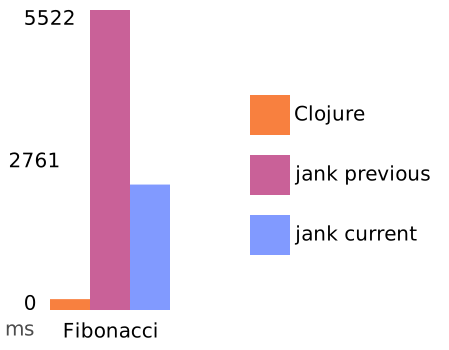
After adding inline support to jank's analyzer and updating the metadata for all arithmetic functions, we can check our new benchmark results. This drops us from 5,522 milliseconds to 2,309 milliseconds. It's nice to start with a huge win.
Eliminating extra IR instructions
Next, let's take a look at the IR for our fibonacci function. I love inspecting the IR for jank functions now, since is provides such a nice view into how the jank compiler sees the code.
{:name user_fibonacci_82580
 :lifted-vars {}
 :lifted-constants {const_82598 2
                    const_82597 1}
 :functions [{:name user_fibonacci_82580_1
              :blocks [{:name entry
                        :instructions [{:name fibonacci :op :parameter :type "jank::runtime::object_ref"}
                                       {:name n :op :parameter :type "jank::runtime::object_ref"}
                                       {:name v3 :op :literal :value 1 :type "jank::runtime::obj::integer_ref"}
                                       {:name v4 :op :cpp/call :value "jank::runtime::lte" :args [n v3] :type "bool"}
                                       {:name v5 :op :cpp/into-object :value v4 :type "jank::runtime::object_ref"}
                                       {:name v7 :op :truthy :value v5 :type "bool"}
                                       {:name v8 :op :branch :condition v7 :then if0 :else else1 :merge nil :shadow nil :type "void"}]}
                       {:name if0
                        :instructions [{:name v9 :op :ret :value n :type "jank::runtime::object_ref"}]}
                       {:name else1
                        :instructions [{:name v10 :op :literal :value 1 :type "jank::runtime::obj::integer_ref"}
                                       {:name v11 :op :cpp/call :value "jank::runtime::sub" :args [n v10] :type "jank::runtime::object_ref"}
                                       {:name v12 :op :named-recursion :fn fibonacci :args [v11] :type "jank::runtime::object_ref"}
                                       {:name v13 :op :literal :value 2 :type "jank::runtime::obj::integer_ref"}
                                       {:name v14 :op :cpp/call :value "jank::runtime::sub" :args [n v13] :type "jank::runtime::object_ref"}
                                       {:name v15 :op :named-recursion :fn fibonacci :args [v14] :type "jank::runtime::object_ref"}
                                       {:name v16 :op :cpp/call :value "jank::runtime::add" :args [v12 v15] :type "jank::runtime::object_ref"}
                                       {:name v17 :op :ret :value v16 :type "jank::runtime::object_ref"}]}]}]}
So we have three blocks in our function. We start at the entry block. We grab our parameter n and the literal 1 and we do our <= check, which has been inlined as a cpp/call instruction which returns bool.
{:name n :op :parameter :type "jank::runtime::object_ref"}
{:name v3 :op :literal :value 1 :type "jank::runtime::obj::integer_ref"}
{:name v4 :op :cpp/call :value "jank::runtime::lte" :args [n v3] :type "bool"}
We then convert that bool into a boxed object and check if it's truthy so we can branch.
{:name v5 :op :cpp/into-object :value v4 :type "jank::runtime::object_ref"}
{:name v7 :op :truthy :value v5 :type "bool"}
{:name v8 :op :branch :condition v7 :then if0 :else else1 :merge nil :shadow nil :type "void"}
This can be optimized away, since the result of our <= check (v4) was already a bool. We turned it into an object just so we can turn it back into a bool. Ideally, the branch condition can just be v4 instead.
Before optimizing that, let's finish examining our IR. We either branch to if0, which just returns our result, or to else1, which then needs to do the recursion. Our else1 branch happens in three steps.
; 1. Recur with `(- n 1)`.
{:name v10 :op :literal :value 1 :type "jank::runtime::obj::integer_ref"}
{:name v11 :op :cpp/call :value "jank::runtime::sub" :args [n v10] :type "jank::runtime::object_ref"}
{:name v12 :op :named-recursion :fn fibonacci :args [v11] :type "jank::runtime::object_ref"}

; 2. Recur with `(- n 2)`.
{:name v13 :op :literal :value 2 :type "jank::runtime::obj::integer_ref"}
{:name v14 :op :cpp/call :value "jank::runtime::sub" :args [n v13] :type "jank::runtime::object_ref"}
{:name v15 :op :named-recursion :fn fibonacci :args [v14] :type "jank::runtime::object_ref"}

; 3. Return the sum of those.
{:name v16 :op :cpp/call :value "jank::runtime::add" :args [v12 v15] :type "jank::runtime::object_ref"}
{:name v17 :op :ret :value v16 :type "jank::runtime::object_ref"}
That's everything! So let's eliminate those extra :cpp/into-object and :truthy instructions and add support to our IR generation for just using bool values directly. The results are that we drop from 2,309 milliseconds to 2,247 milliseconds. That's quite marginal, given our overall magnitude. It's nice that the IR no longer has any extraneous work in it, though. We could lift those two :literal instructions for 1 so there's just one of them, but that's not going to affect our performance, so I'll leave it for now.
{:name entry
 :instructions [{:name fibonacci :op :parameter :type "jank::runtime::object_ref"}
                {:name n :op :parameter :type "jank::runtime::object_ref"}
                {:name v3 :op :literal :value 1 :type "jank::runtime::obj::integer_ref"}
                {:name v4 :op :cpp/call :value "jank::runtime::lte" :args [n v3] :type "bool"}
                {:name v6 :op :branch :condition v4 :then if0 :else else1 :merge nil :shadow nil :type "void"}]}
{:name if0
 :instructions [{:name v7 :op :ret :value n :type "jank::runtime::object_ref"}]}
{:name else1
 :instructions [{:name v8 :op :literal :value 1 :type "jank::runtime::obj::integer_ref"}
                {:name v9 :op :cpp/call :value "jank::runtime::sub" :args [n v8] :type "jank::runtime::object_ref"}
                {:name v10 :op :named-recursion :fn fibonacci :args [v9] :type "jank::runtime::object_ref"}
                {:name v11 :op :literal :value 2 :type "jank::runtime::obj::integer_ref"}
                {:name v12 :op :cpp/call :value "jank::runtime::sub" :args [n v11] :type "jank::runtime::object_ref"}
                {:name v13 :op :named-recursion :fn fibonacci :args [v12] :type "jank::runtime::object_ref"}
                {:name v14 :op :cpp/call :value "jank::runtime::add" :args [v10 v13] :type "jank::runtime::object_ref"}
                {:name v15 :op :ret :value v14 :type "jank::runtime::object_ref"}]}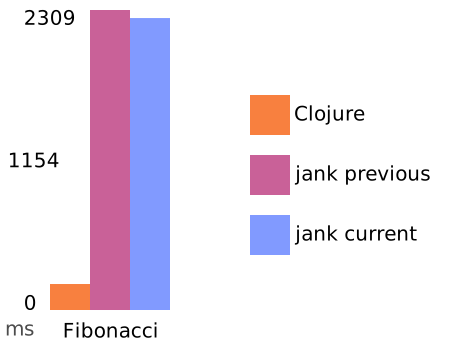
Optimizing nil usage
At this point, the IR looks good and I have no other planned optimizations, so let's take a look at a flamegraph to see where our time is being spent. You can click this image to open it in a new tab and see the details, if you'd like. I'll cover the essentials here anyway.
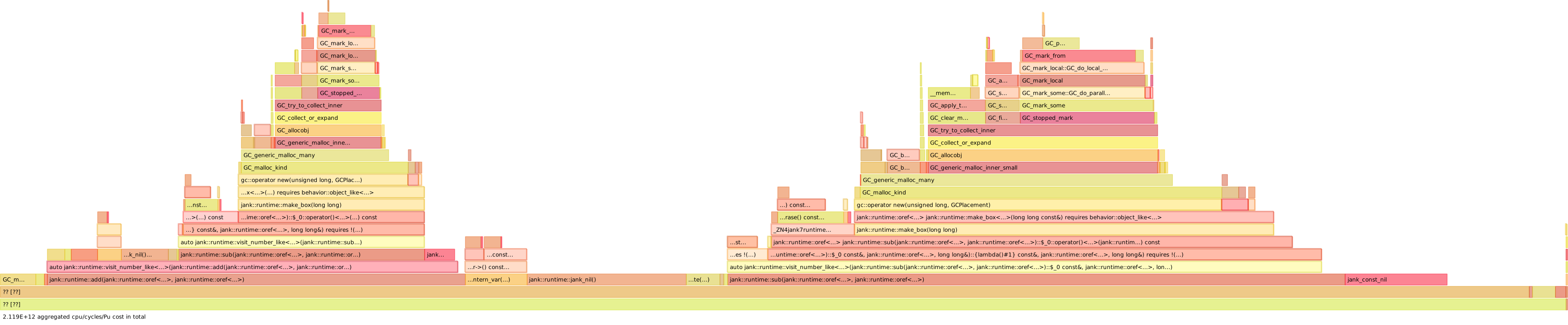
We're expecting to see arithmetic, and calls to fibonacci, but curiously we see a LOT of time spent in jank_nil and jank_const_nil. As a Clojure dialect, we access nil very often, since we need to check if things are nil, initialize things to nil, and lots of expressions evaluate to nil. However, that shouldn't show up in the profiler! It does because jank currently puts its nil value behind a function for some very in-the-weeds reasons. C++ doesn't guarantee initialization order for globals across translation units and any translation units jank AOT compiles will be full of globals (lifted constants) which will want to initialize their values to be nil. If nil is defined as a global in another translation unit, as part of the jank runtime, we might try to use it before it's initialized. So we've been working around that by putting nil behind a function called jank_nil, but apparently this has had a heavy performance cost.
jank's boxed pointer type doesn't allow initialization with nullptr, since that's not a valid value. jank separates nil from nullptr since dereferencing nil is well-defined, in Clojure, but dereferencing nullptr is undefined behavior in C++. We simply just can't do it. But I happen to know that we don't care about the default construction of the globals we generate for AOT compiled code, since we later re-initialize them when the module is loaded. So let's add a custom constructor to our boxed pointer type which actually initializes them to nullptr because we know we'll be re-initializing them with nil later. Then we can just keep jank_nil as a global value instead of a function.
This brings us from 2,247 milliseconds to 1,400 milliseconds!
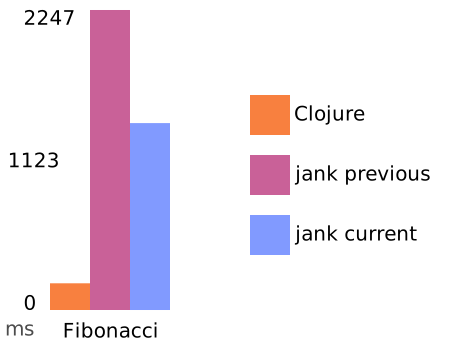
That's a big win! This qualifies as the runtime getting in the way of our benchmark, so it's nice to clear that up. We're still over 5x slower than Clojure JVM, though, so it's time to cut off some more huge chunks.
Why are add/sub slow?
If we look at the rest of the flamegraph embedded above, we see the expected suspects. Namely, add and sub. The slowest parts of those functions, the flamegraph tells us, is the GC allocation of new numbers. Every single integer result from adding or subtracting is a new dynamic allocation. At this point, we're spending basically our entire time just allocating numbers.
You might wonder why we're not using unboxed numbers for this. Or you might think "Just add a type hint! Clojure supports those!". But that misses the point of this benchmark. This benchmark is specifically written to challenge the compiler and runtime. Let's take a look at our Clojure code one more time and I'll explain why.
(defn fibonacci [n]
  (if (<= n 1)
    n
    (+ (fibonacci (- n 1))
       (fibonacci (- n 2)))))
Here, the type of n is just going to be a type-erased object. In Clojure JVM, it will be a Java Object. In jank, it's a jank::runtime::object_ref. Either way, we have no idea what kind of object is in there. When we do (- n 1) and (- n 2), we still don't know the type of n. It could be a float. It could be an integer. It could be a ratio. It could be a big decimal or big integer. It could be something which doesn't even support arithmetic. So we need to do a whole polymorphic dance to handle arithmetic on n. Fortunately, we know the types of 1 and 2, so we can optimize for that, but it's not enough to unbox any of this arithmetic. The same thing applies to the + call. We don't know the return type of fibonacci. We either return n, which we don't know the type of, or we return the result of + with both inputs being the return from fibonacci, which we still don't know the type of. So there's nothing we can do here statically either. This is the key aspect that makes this benchmark difficult. The JVM is doing a much better job of it than we are, currently.
Pointer tagging
To remedy this, let's just avoid dynamic allocations for integers entirely. There are some well-known tricks used by language runtimes to do exactly that and jank isn't yet using any of them. We'll start with the simplest trick and then build to a more complex design in a later benchmark post.
Did you know that, on 64 bit sytems, the bottom three bits of pointers are effectively unused? This is because pointers are aligned to 64 bit machine words. For example, an aligned pointer exists at address 0, 8, 16, 24, and so on. But an aligned pointer will not exist at an address which is not divisible by 8 bytes (64 bits). The bottom three bits of a pointer, 000, are for the 1's place (lowest bit), 2's place (middle bit), and 4's place (highest bit). If all bits are on, 111, we have the value 7 (4 + 2 + 1). If you add one more, we get 8 and all three lowest bits go back to 0.
This is an incredible piece of knowledge, since it means that we can embed extra information in our pointers very easily. For example, if we set the lowest bit to 1, we can convey that the pointer is not actually a pointer. Instead, it's an encoded integer. We can then use the other 63 bits to store the actual integer value. This way, as long as our integers don't need to store values higher than what 63 bits can manage, we can store them inline without needing to do a dynamic allocation! In the case where we need all 64 bits, we can just do an allocation like we normally would and we'd get a normal pointer (lowest three bits all 0) to a boxed integer.
To visualize this, a normal 64 bit pointer would look like this. The highest 61 bits are used for pointer data and the lowest three bits are 0.
pppppppp pppppppp pppppppp pppppppp pppppppp pppppppp pppppppp ppppp000
An encoded integer would look like this. The lowest bit is 1 and the rest is reserved for integer data. To get the actual 63 bit integer, we just shift the whole thing to the right once.
xxxxxxxx xxxxxxxx xxxxxxxx xxxxxxxx xxxxxxxx xxxxxxxx xxxxxxxx xxxxxxx1
For our fibonacci benchmark, and indeed for basically every benchmark and real-world application, this is going to effectively eliminate every dynamic allocation for integers. Let's see how it affects our numbers.
With tagged pointers to optimize for 63 bit integers, jank goes from 1,400 milliseconds to 282 milliseconds. As I said, we were basically spending all of our time allocating integers. Even better, this puts us within reach of Clojure's 200 milliseconds.
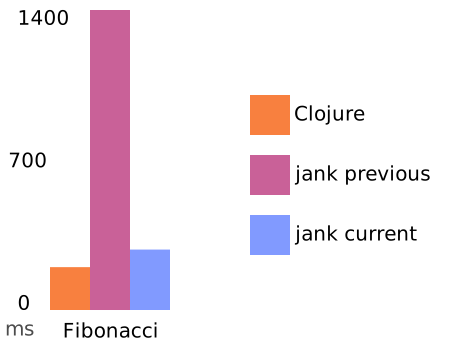
Intense inlining
Let's take a look at a new flamegraph with our latest changes and see how we can trim off the extra fat. Again, you can click this image to open it in a new tab, if you'd like. Or just take my word for it.
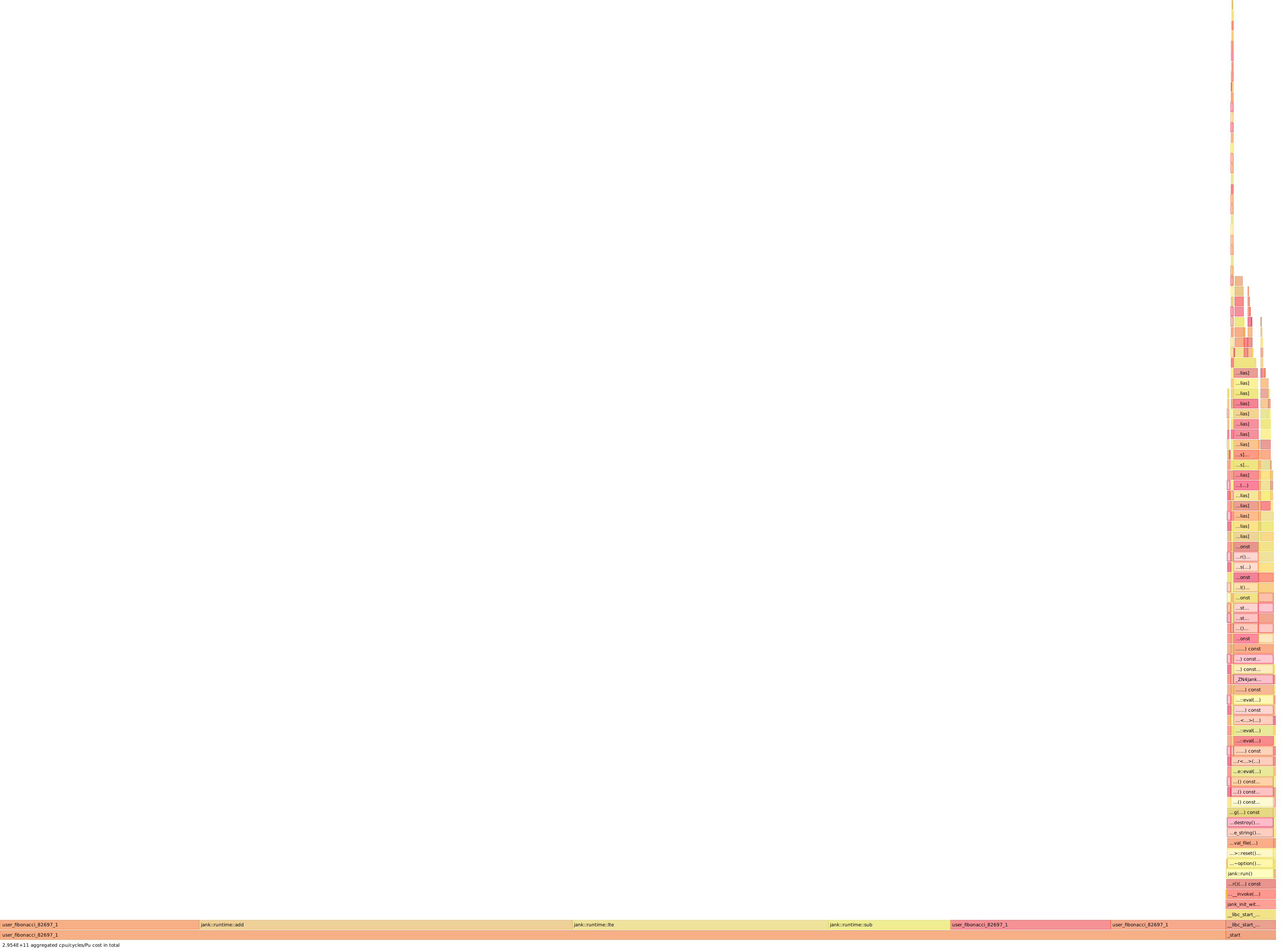
Ideally, what we see here is just fibonacci and nothing more, since everything that matters should have been inlined. Instead, we see jank::runtime::add, jank::runtime::sub, and jank::runtime::lte. This means those calls have not been inlined by Clang. Let's try to tell Clang to always inline our arithmetic functions. We can do this by putting some attributes on the C++ add, sub, etc functions. Modern C++ syntax makes this easy.
template <typename L, typename R>
[[gnu::always_inline, gnu::flatten, gnu::hot]]
auto add(L const l, R const r)
{ ... }
Arithmetic is something we always want to be fast, so there's no better thing to inline than number crunching. Now we can try again. Fortunately, with a sigh of relief, this drops jank from 282 milliseconds to 114 milliseconds. We're nearly twice as fast as Clojure JVM! Better yet, we're gone from taking 5,522 milliseconds to taking 114 milliseconds and we're effectively doing the same work.
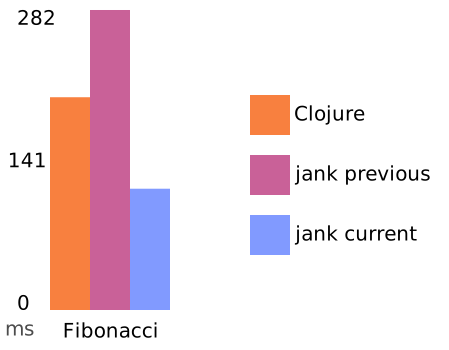
I once saw an interview with an artist who does chainsaw sculptures. The interviewer asked him how he approaches sculpting something like a bear out of a huge log. He said "I just remove everything that doesn't look like a bear". While that's not a particularly helpful answer, optimization is quite similar. When we're profiling and taking a look at how the time is being spent, we just need to remove all of the time spent NOT doing the most essential tasks. Generally, that just means figuring out what the essential tasks are and then figuring out how to not do everything else.
What's next
One benchmark down, many more to go. Next, I will be revisiting a ray tracer I wrote in Clojure a couple of years ago and we will utilize our new IR and optimized runtime to see how fast we can push jank. This post, and this first benchmark, is just the start. I will be spending the next couple of months tackling more and more benchmarks, of varying sizes, to ensure jank is reasonably fast in every practical sense. This is all building up to jank's beta release.
A note about the JVM versus native
Many folks who use jank for the first time end up saying something along the lines of "Why is jank slow? Isn't it written in C++?" So, firstly, jank is slow because it's unoptimized. As we can see here, jank can absolutely compete with the JVM in this micro-benchmark and I will show in future posts that we can do so in larger benchmarks, too. Secondly, you know what's also written in C++? The JVM. jank is indeed a miniature JVM, with some key distinctions.
The JVM has not only a just-in-time (JIT) compiler, but also a JIT optimizer. The JVM will adaptively perform inter-procedural optimizations, at run-time, based on which functions are called, how often, and with which values. This is an incredible piece of engineering.
In the native world, we don't currently have JIT optimization. It could exist, but LLVM doesn't have any implementation for it and neither does any major C or C++ compiler. Furthermore, the entire native ecosystem is not designed for it, whereas it's truly taken for granted in the JVM space. This means that JVM programs get faster and faster, the more you use them, up to a certain point. However, if jank is faster than Clojure, it's because it started that fast and stayed that fast.
Finally, just because jank is written in C++ doesn't mean that we can escape Clojure's semantics. Clojure is dynamically typed, garbage collected, and polymorphic as all get out. Regardless of the language used for the compiler and runtime, all of these semantics need to be preserved for a true Clojure dialect. If we were to rewrite this benchmark in actual idiomatic C++, there would be no contest between it and Clojure. C++ would just win, since it's statically typed, uses primitive arithmetic, has almost no runtime, and Clang, in particular, has world-class AOT optimization. This applies even if you type-hint the Clojure code. Try it, if you don't believe me. I did, when writing this. :)