Welcome back! It's been three months since my last post and the amount of improvements to jank are staggering. Let me tell you all about it! Before jumping into the details, though, I want to say thank you to my Github sponsors and to Clojurists Together for sponsoring me this whole year. Thank you!
Error reporting
Last year, I published a post showcasing how jank has reimagined Clojure errors. In every way, I aim for jank compiler errors to be more helpful, provide more context, and be more visually appealing than the Clojure JVM counterpart. Even in complex scenarios involving macros, jank excels.
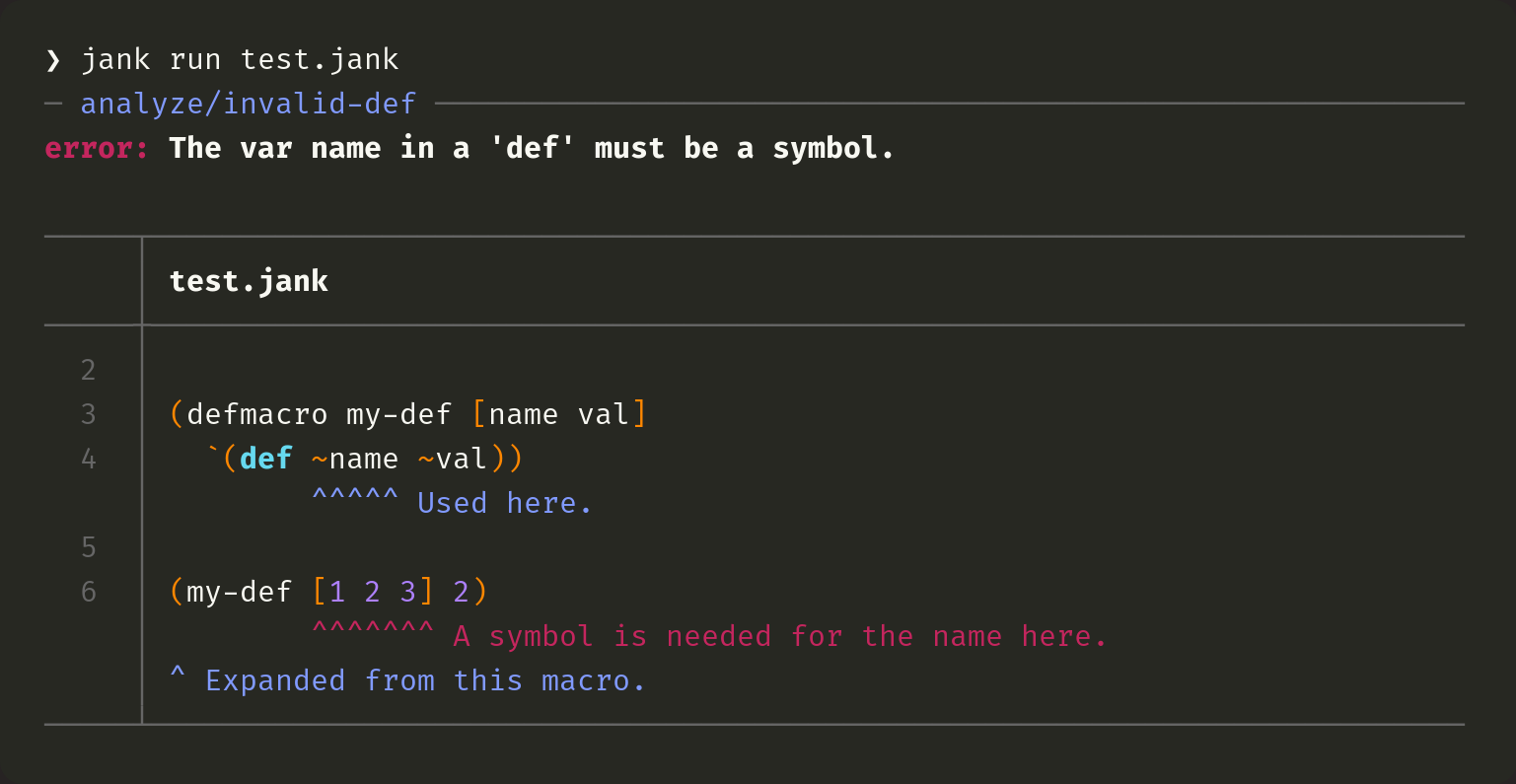
However, I hadn't yet tackled a couple of other areas of error reporting: runtime exceptions and C++ interop errors.
Uncaught runtime exceptions
In today's modern C++ compilers, there's no standard, portable way to get a stack trace. Coming from the JVM, this may sound surprising, but it's par for course in the native world. Even worse, jank is JIT compiling C++ code and we want to get accurate stack traces which include those frames as well. Even worse, we need to map some of that C++ back to actual jank code. So, in order to get beautiful, accurate stack traces for jank's uncaught runtime exceptions, there was a lot of work to be done. Check out the results!
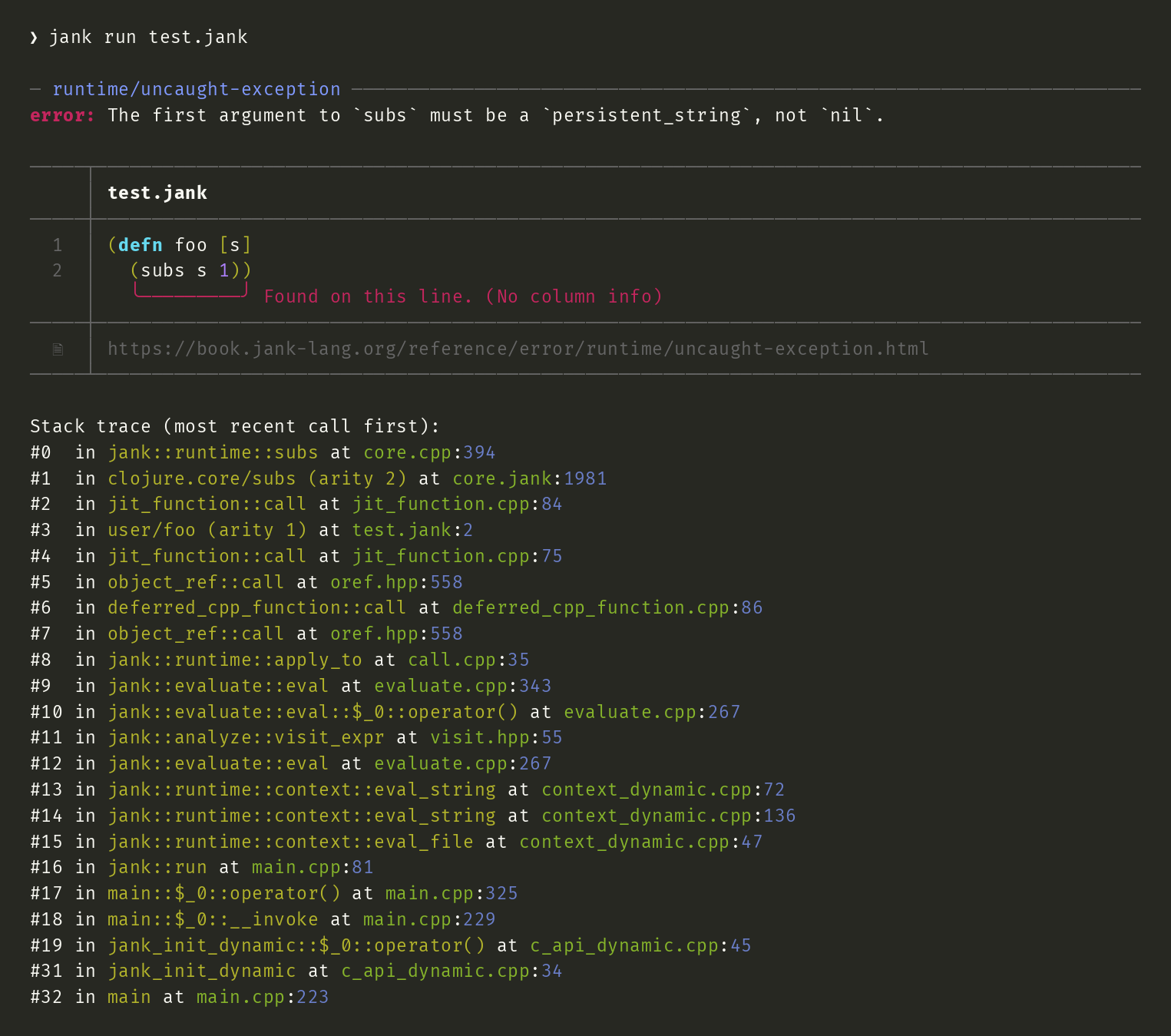
As you can see in the figure above, an exception was thrown from the C++ code backing clojure.core/subs. jank properly reports the error by pointing at the nearest user's Clojure call, skipping over the one in clojure.core which calls the C++ function. In the stack trace, we can see two Clojure-specific frames, numbered as #1 and #3. First, we see the frame for clojure.core/subs. Then we see the frame for user/foo, which actually does the call to subs. Note that both of these frames include the exact arity that was used, as well as the precise source location in their respective jank files.
What you're not seeing here is that this stack trace is pulling debug info from three separate places:
- The current executable, for all of the non-Clojure frames.
- An AOT-compiled object file, which was loaded when
clojure.corewas required. This is equivalent to Clojure JVM's.classfiles. - A JIT-compiled object file, which was added to the LLVM JIT runtime when the
user/foofunction was compiled.
After my recent efforts, jank now weaves all of these together seamlessly to provide you a lovely error report. This works reliably on macOS and on Linux.
Error pages
Building on the error output above, you may also notice the URL that's tucked into the bottom of the code snippet. Since the original error reporting design last year, I have intended for jank to have a dedicated error page for each error. Each page should provide more information about the error, common causes, and suggested fixes. All of these pages have now been created and are part of the jank book. Some of them are more bare-bones than others and I plan to continue filling them in over time. Getting them created sooner will start aiding in SEO, though, which will help ensure that if you search for any jank errors you hit, the right resources will be shown to you.
Here's an example of what I have in mind: analyze/invalid-cpp-conversion
C++ candidates
I have saved the best for last, as far as error messages go. We know that Clojure is infamous for its error messages and I hope to have shown how jank addresses that. However, C++ is also infamous for its error messages and jank is just as much C++ as it is Clojure. C++ is a much scarier beast when it comes to all of the possible things that can go wrong, though. So how can we reimagine C++ error messages? Well, I gave it my best shot. Take a look. :)
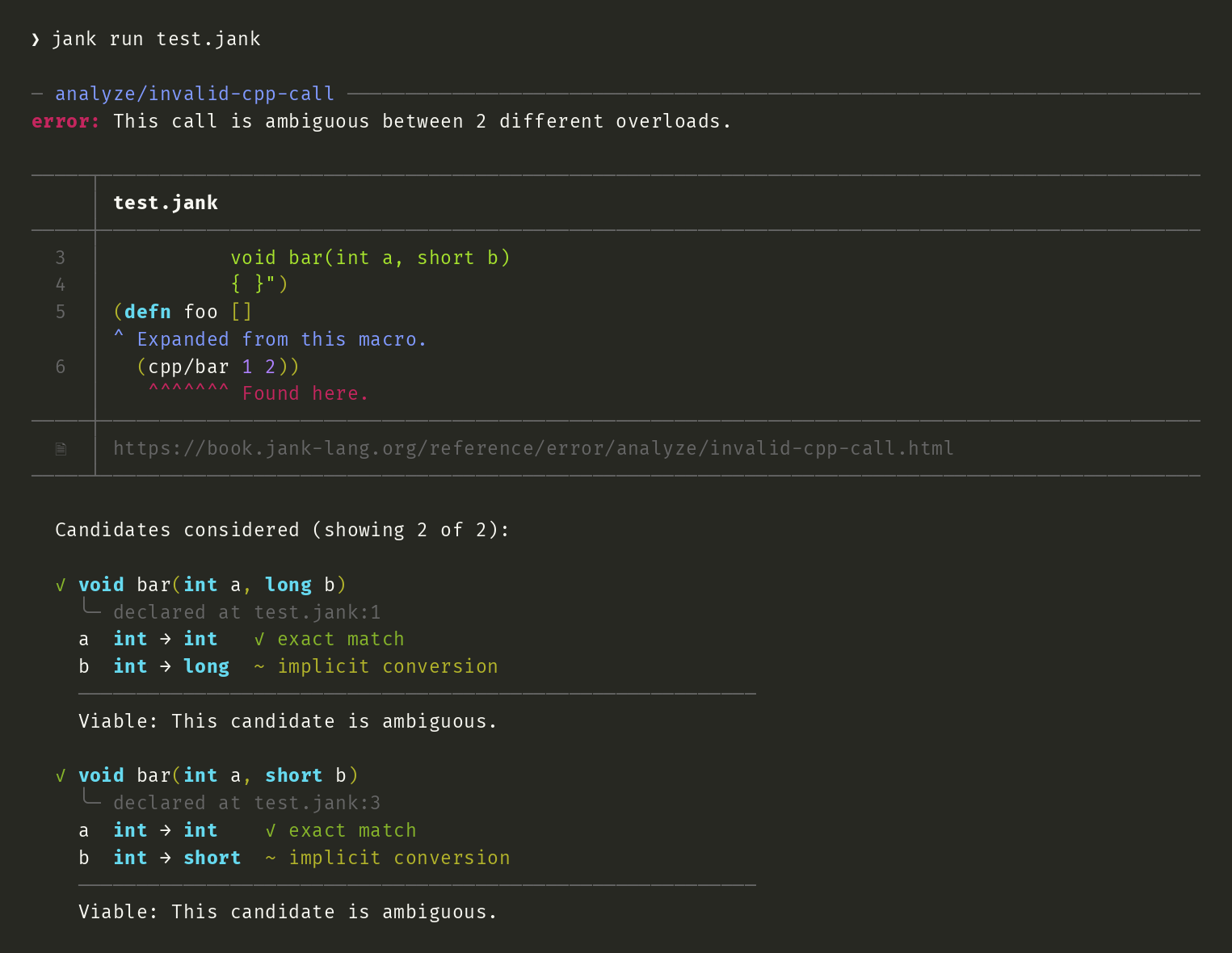
The call is ambiguous because the second argument is an int, which directly matches neither long nor short but can implicitly be converted to either of them. jank's AST is intertwined with Clang's AST, so we can extract all of the necessary information to render this neatly. Unlike Clang, or GCC, jank renders these in a table format which I find to be incredibly succinct and appealing.
Also, as a bonus, the signature and source information for these bar functions is correct, even when they're declared inside of a cpp/raw in a jank file. Let's take a look at another one.
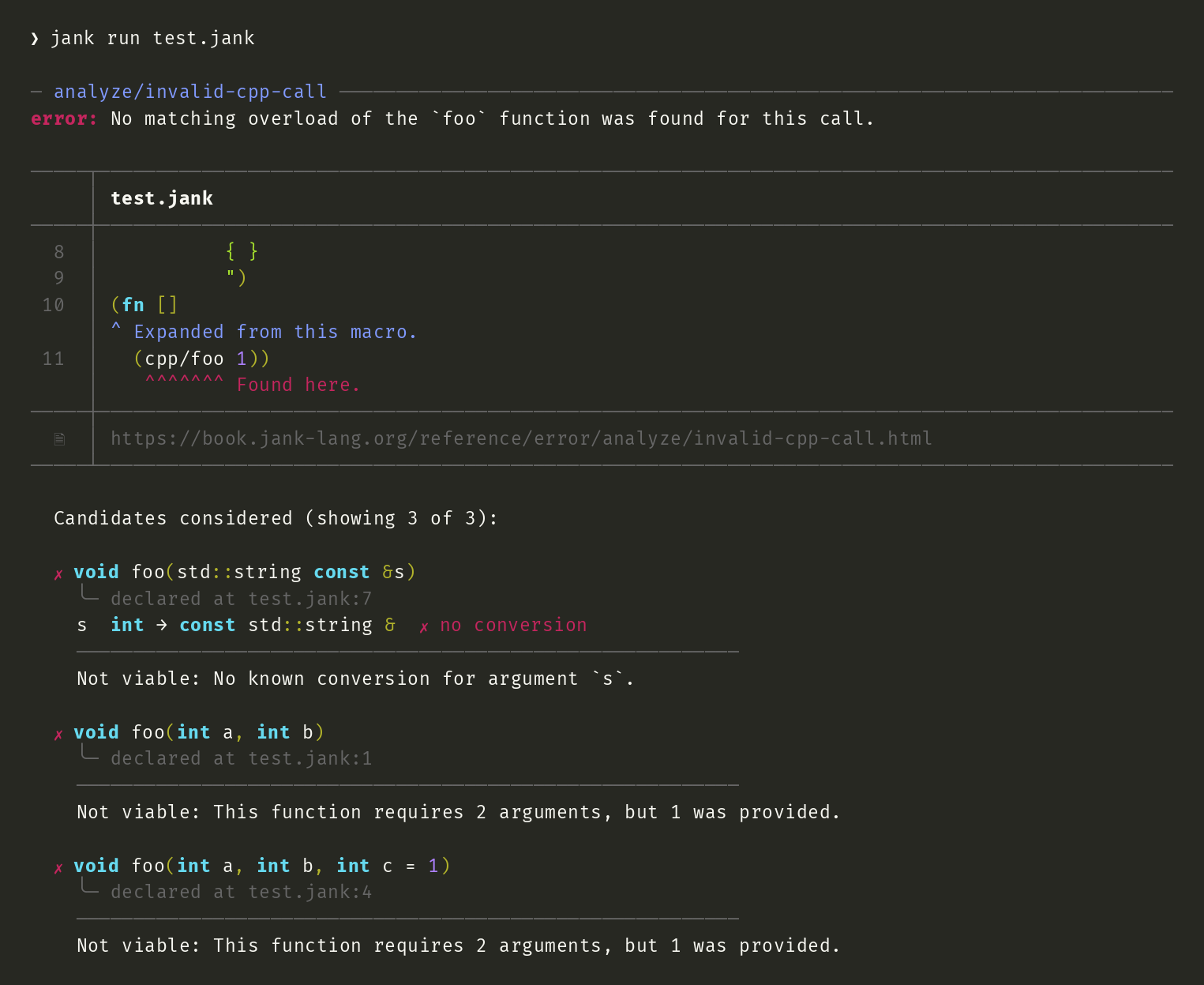
When there are many candidates to report, jank optimizes useful output by ranking the candidates based on argument count, required conversions, as well as access levels. By default, jank will only show the top three candidates.
Finally, I'll show one more image, which is of a special kind of ambiguity with some jank-specific behavior. On top of normal C++ overloading, implicit conversions, etc, jank also supports automatic trait conversions, which use a well-known trait to convert to/from jank objects and native values. If an argument to a native function is a jank object, the compiler will consider whether or not a trait conversion can be used. However, this can result in ambiguities, too, if multiple candidates are viable. Here's an example.
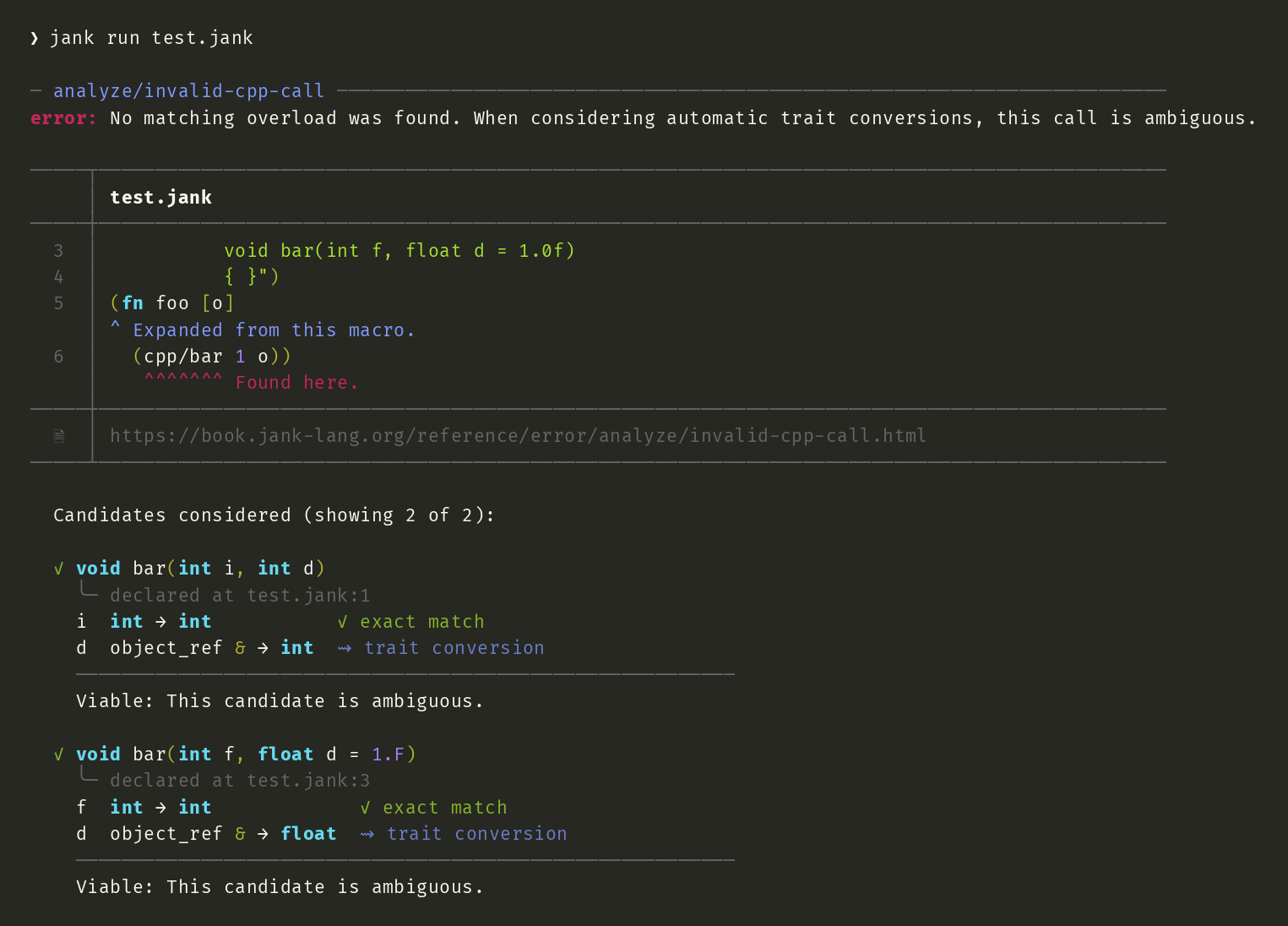
There's a lot more that jank can already do with these C++ candidate failures, but I can only show so much in a blog post. I'm sure you'll see more next time you're writing some jank code!
Why bother with all of this?
You may not be as excited as I am about these images of error reports. That's understandable. It's partly a compiler nerd thing, since effective error reporting can be quite tricky. However, it's also partly a huge usability win over not only Clojure JVM, not only Clang and GCC, but also the status quo in a lot of developer tooling. I am trying to build a language, and tooling ecosystem, that is the best it can be. That's the language I want to use. I want to entice others to try it by dedicating this time to usability, too.
To me, this is incredibly important.
Interlude
Before we move on to the next topic, please consider subscribing to jank's mailing list. This is a great way to make sure you stay up to date with jank's releases, jank-related talks, workshops, and so on. It's very low traffic.
Also, while we're in this interlude, are you sponsoring me? If so, you're the best! Thank you. If not, did you know I've been working on jank full-time for nearly two years, relying on Github sponsors and Clojurists Together grants as my sole income? If you're able to chip in $10 per month, please do!
Native build system
Another large system I've been working on is jank's native build system. This is a Cargo-like build system, for those familiar with Rust. The goal of the build system is to enable easy consumption of native libraries, both from the installed system and from compiled sources. The jank build system stands on top of Clojure's existing package management, namely through Clojars. When you add a dependency, the jank tooling will automatically pick up if that dependency has a native jank build script and will build the package locally. These scripts are always run in a sandbox which has no access to your personal files. This is an improvement over the default Cargo machinery.
This build system was originally created by Kyle Cesare and I've been further improving it these past few months by adding sandboxing support to macOS, improving static linking support, and overall making things more robust and stable. Now that we have a powerful native build system, what we need is a repository of high quality packages. That is precisely why I started the jank commons.
jank commons
The jank commons is an official repository of native jank packages published to Clojars. Each of these packages integrates seamlessly into the jank build system and has an example project which is continuously compiled. Following Rust/Cargo's naming scheme, the jank commons is currently full of foo-sys packages. The -sys suffix conveys that it's a package which provides a system library without providing a higher level API. Writing a higher level API is left up to other packages which then depend on the -sys packages. The key benefit here is that the higher level packages don't need to bother with all of the system details of packaging native libs and can just focus on writing good APIs. Another benefit is that generally only -sys packages will need native build scripts, so isolating those can further help with security. Even better, since jank has seamless C++ interop, idiomatic Clojure APIs are optional.
An even easier way to browse the native packages jank has is through the awesome-jank list. This is mainly populated by the jank commons right now, but please take this to be a call to action to get more native libs packaged for jank! The jank commons README has a guide for exactly how to do this and the whole native build system is thoroughly documented in the jank book.
Everything else
There's a lot more that's been going on in the jank repos, but it's too much to cover in detail here. For example:
- The terminal REPL client has been rewritten to support syntax highlighting, tab completion, and multi-line inputs
- Syntax quote expansion has been drastically optimized, cutting generated code size from macros down substantially
- Multiple Clang/LLVM bugs have been fixed and upstreamed for LLVM 23, resulting in more graceful jank updates and more robust exception handling on macOS
- Support for throwing (and re-throwing) native values has been added
- The nREPL server received some usability improvements
What's next
This is the last post before my talk at Clojure Conj 2026. If you can't make it, check out the free live stream! In the coming weeks, I will be racing to improve jank's stability, portability, and usability, leading up to the Conj. After the Conj, and for the remainder of the year, I'll be focused on much of the same.
It's my goal to get jank into your hands, dear reader. For many of you, I think that jank is already capable enough for you to begin your tinkering. With the addition of the jank commons, starting a new raylib game in jank is as easy as lein run. Getting a distributable binary is as easy as lein compile. What follows is just polishing up all of the rough edges so that developing your games and applications is a breeze.
If you've been waiting to try jank, give it a go! If there's something you need which jank is missing, let me know! I'll make sure it's noted down and prioritized.
I'll see you all at the Conj.